Beschreibung
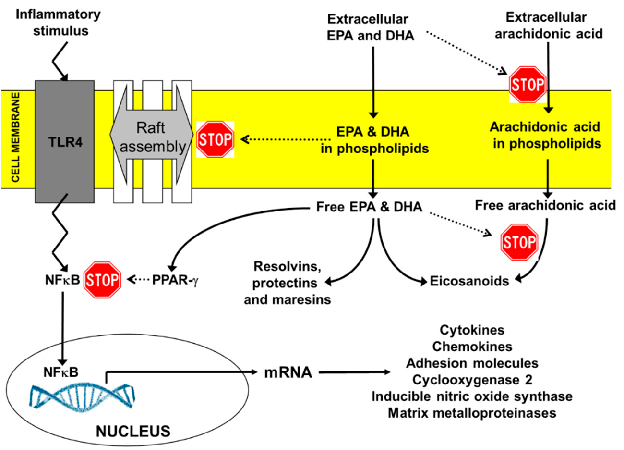
Key anti-inflammatory actions of EPA and DHA include suppression of NF-kB activation, reduction of pro-inflammatory eicosanoid production, inhibition of NLRP3 inflammasome activation, and promotion of regulatory T-cell differentiation through PPAR-gamma signaling.
Figure 5
Diagram
624 × 450px
· 118,9 KB
Source Paper
Expert Opinion on Benefits of Long-Chain Omega-3 Fatty Acids (DHA and EPA) in Aging and Clinical Nutrition.Cite This Figure
 > Source: Barbara Troesch et al. "Expert Opinion on Benefits of Long-Chain Omega-3 Fatty Acids (DHA and EPA) in Ag." *Nutrients*, 2020. PMID: [32846900](https://pubmed.ncbi.nlm.nih.gov/32846900/)
<figure>
  <img src="https://pdfs.citedhealth.com/figures/32846900/108.png" alt="Key anti-inflammatory actions of EPA and DHA include suppression of NF-kB activation, reduction of pro-inflammatory eicosanoid production, inhibition of NLRP3 inflammasome activation, and promotion of regulatory T-cell differentiation through PPAR-gamma signaling." />
  <figcaption>Figure 5. Key anti-inflammatory actions of EPA and DHA include suppression of NF-kB activation, reduction of pro-inflammatory eicosanoid production, inhibition of NLRP3 inflammasome activation, and promotion of regulatory T-cell differentiation through PPAR-gamma signaling.<br>  Source: Barbara Troesch et al. "Expert Opinion on Benefits of Long-Chain Omega-3 Fatty Acids (DHA and EPA) in Ag." <em>Nutrients</em>, 2020. PMID: <a href="https://pubmed.ncbi.nlm.nih.gov/32846900/">32846900</a></figcaption>
</figure>