BrainCited
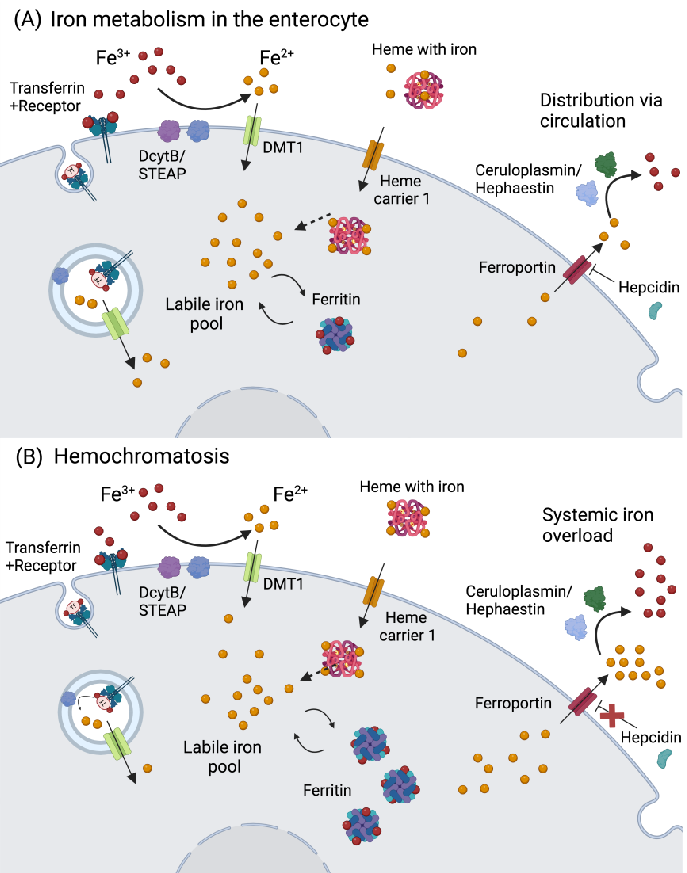
Figure 1. Iron metabolism in the enterocyte and hemochromatosis. (A) Iron is absorbed as Fe2+ through reduction by DcytB/STEAP, and transported via DMT1. In the case iron is bound to heme, it can be transported via heme carrier 1. Another route is via rec
Figure 2. Figure 1. Iron metabolism in the enterocyte and hemochromatosis. (A) Iron is absorbed as Fe2+ through reduction by DcytB/STEAP, and transported via DMT1. In the case iron is bound to heme, it can be transported via heme carrier 1. Another route is via receptor-mediated endocytosis bound to transferrin. Afterwards, iron can be stored in the form of ferritin, used for the biosynthesis of Fe-S clusters, or integrate the cellular labile iron pool. The iron in the labile iron pool can bind to ferritin, and vice-versa. If iron is not stored or used, it will be exported to the circulation via ferroportin, and oxidized to ferric iron by hephaestin (in the intestine) or ceruloplasmin. Iron export via ferroportin is regulated by hepcidin, which is produced by the liver. (B) In hemochromatosis, hepcidin expression is low, thus ferroportin activity is left unregulated, resulting in an increase in iron efflux in the circulation. Abbreviations: DcytB: ferrireductase duodenal cytochrome b; DMT1: divalent metal transporter 1; Fe: iron; STEAP: six-transmembrane epithelial antigen of the prostate. Created in BioRender.com (accessed on 19 May 2024).

Figure 2

687 × 873px · 184,4 Kio

Source Paper

Metabolic Derangement of Essential Transition Metals and Potential Antioxidant Therapies.

International journal of molecular sciences (2024)

PMID: 39063122

DOI: 10.3390/ijms25147880

Cite This Figure

![Figure 2: Figure 1. Iron metabolism in the enterocyte and hemochromatosis. (A) Iron is absorbed as Fe2+ through reduction by DcytB/STEAP, and transported via DMT1. In the case iron is bound to heme, it can be transported via heme carrier 1. Another route is via rec](https://pdfs.citedhealth.com/figures/39063122/96.png)

> Source: Adriana Fontes et al. "Metabolic Derangement of Essential Transition Metals and Potential Antioxidant T." *International journal of molecular sciences*, 2024. PMID: [39063122](https://pubmed.ncbi.nlm.nih.gov/39063122/)
<figure>
  <img src="https://pdfs.citedhealth.com/figures/39063122/96.png" alt="Figure 1. Iron metabolism in the enterocyte and hemochromatosis. (A) Iron is absorbed as Fe2+ through reduction by DcytB/STEAP, and transported via DMT1. In the case iron is bound to heme, it can be transported via heme carrier 1. Another route is via rec" />
  <figcaption>Figure 2. Figure 1. Iron metabolism in the enterocyte and hemochromatosis. (A) Iron is absorbed as Fe2+ through reduction by DcytB/STEAP, and transported via DMT1. In the case iron is bound to heme, it can be transported via heme carrier 1. Another route is via rec<br>  Source: Adriana Fontes et al. "Metabolic Derangement of Essential Transition Metals and Potential Antioxidant T." <em>International journal of molecular sciences</em>, 2024. PMID: <a href="https://pubmed.ncbi.nlm.nih.gov/39063122/">39063122</a></figcaption>
</figure>
