BrainCited
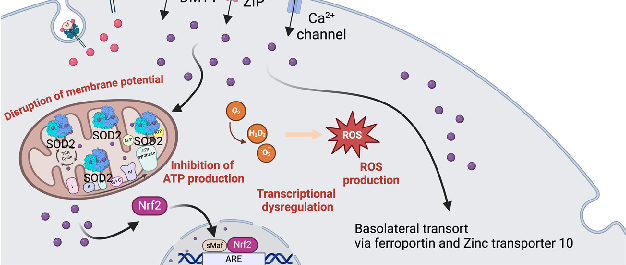
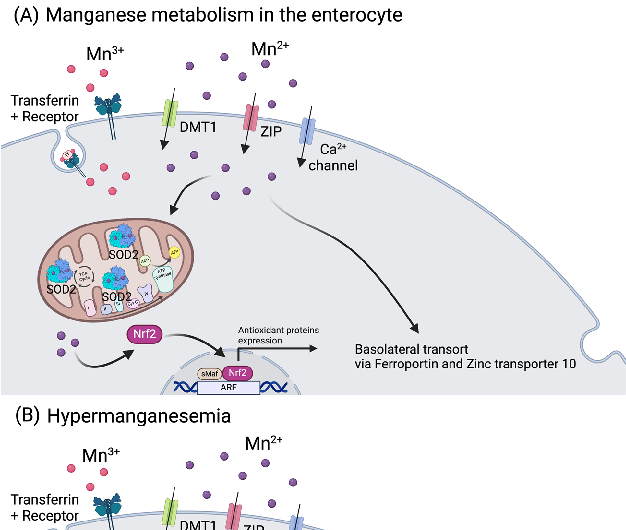
Figure 4. Manganese metabolism and hypermanganesemia. (A) Manganese can be taken up as Mn2+ via DMT1, ZIP, or Ca2+ channels, or as Mn3+ by binding to transferrin. In mitochondria, Mn2+ works as a cofactor for MnSOD (SOD2). Manganese (Mn2+) can also influe
Figure 7. Figure 4. Manganese metabolism and hypermanganesemia. (A) Manganese can be taken up as Mn2+ via DMT1, ZIP, or Ca2+ channels, or as Mn3+ by binding to transferrin. In mitochondria, Mn2+ works as a cofactor for MnSOD (SOD2). Manganese (Mn2+) can also influence the expression of genes (i.e., antioxidant proteins) by binding to nuclear transcription factors. Basolateral manganese release occurs mainly via ferroportin and zinc transporter 10. (B) In excess, as happens in hypermanganesemia, manganese accumulates in the mitochondria, leading to inhibition of ATP production and disruption of the membrane potential, and in the nucleus, where it dysregulates gene transcription. Both situations lead to an increase in ROS production. Abbreviations: ARE: antioxidant response elements; Ca: calcium; DMT1: divalent metal transporter 1; Nrf2: nuclear factor erythroid 2; ROS: reactive oxygen species; sMaf: small MAF; SOD2: superoxide dismutase 2; ZIP: Zrt-, Irt-like protein family. Created with BioRender.com.

Figure 7

626 × 265px · 115,1 KB

Source Paper

Metabolic Derangement of Essential Transition Metals and Potential Antioxidant Therapies.

International journal of molecular sciences (2024)

PMID: 39063122

DOI: 10.3390/ijms25147880

Cite This Figure

![Figure 7: Figure 4. Manganese metabolism and hypermanganesemia. (A) Manganese can be taken up as Mn2+ via DMT1, ZIP, or Ca2+ channels, or as Mn3+ by binding to transferrin. In mitochondria, Mn2+ works as a cofactor for MnSOD (SOD2). Manganese (Mn2+) can also influe](https://pdfs.citedhealth.com/figures/39063122/163.png)

> Source: Adriana Fontes et al. "Metabolic Derangement of Essential Transition Metals and Potential Antioxidant T." *International journal of molecular sciences*, 2024. PMID: [39063122](https://pubmed.ncbi.nlm.nih.gov/39063122/)
<figure>
  <img src="https://pdfs.citedhealth.com/figures/39063122/163.png" alt="Figure 4. Manganese metabolism and hypermanganesemia. (A) Manganese can be taken up as Mn2+ via DMT1, ZIP, or Ca2+ channels, or as Mn3+ by binding to transferrin. In mitochondria, Mn2+ works as a cofactor for MnSOD (SOD2). Manganese (Mn2+) can also influe" />
  <figcaption>Figure 7. Figure 4. Manganese metabolism and hypermanganesemia. (A) Manganese can be taken up as Mn2+ via DMT1, ZIP, or Ca2+ channels, or as Mn3+ by binding to transferrin. In mitochondria, Mn2+ works as a cofactor for MnSOD (SOD2). Manganese (Mn2+) can also influe<br>  Source: Adriana Fontes et al. "Metabolic Derangement of Essential Transition Metals and Potential Antioxidant T." <em>International journal of molecular sciences</em>, 2024. PMID: <a href="https://pubmed.ncbi.nlm.nih.gov/39063122/">39063122</a></figcaption>
</figure>
