Beschreibung
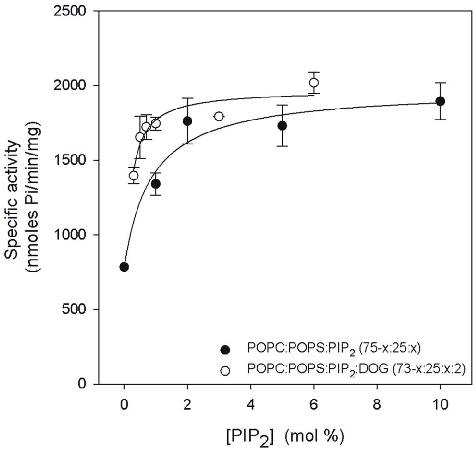
The relationship between PIP2 concentration and PKCα activity demonstrates that increasing PIP2 in lipid vesicles progressively enhances kinase activation efficiency.
More Figures from This Paper
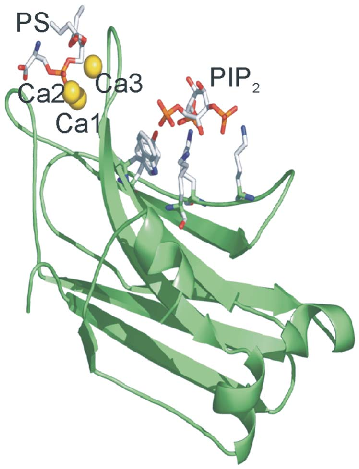
Figure 1
The crystal structure of the PKCα C2 domain bound to calcium, phosphatidylserine, and PIP2 in a quaternary complex is rendered, showing the spatial arrangement of lipid-binding sites.
diagram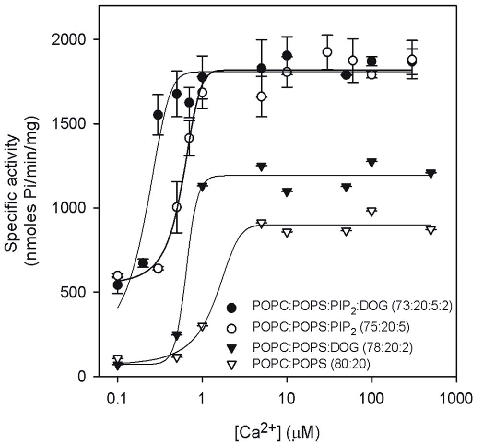
Figure 2
PKCα enzymatic activity is plotted as a function of calcium concentration, demonstrating how PIP2 reduces the calcium requirement for maximal kinase activation.
chart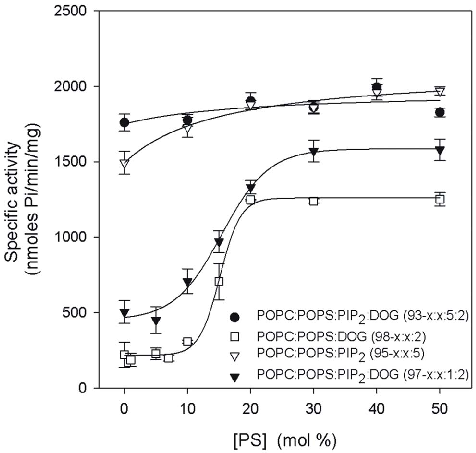
Figure 3
The dependence of PKCα activity on phosphatidylserine (POPS) concentration in lipid vesicles reveals that PIP2 lowers the threshold of phosphatidylserine needed for enzyme activation.
chart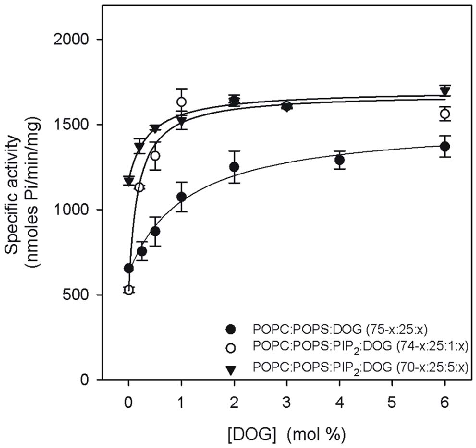
Figure 4
PKCα activity is shown as a function of diacylglycerol (DOG) molar percentage in lipid vesicles, illustrating the cofactor requirements for kinase activation.
chartFigure 5
ChartSource Paper
Phosphatidylinositol 4,5-bisphosphate decreases the concentration of Ca2+, phosphatidylserine and diacylglycerol required for protein kinase C α to reach maximum activity.Cite This Figure
 > Source: Antonio L Egea-Jiménez et al. "Phosphatidylinositol 4,5-bisphosphate decreases the concentration of Ca2+, phosp." *PloS one*, 2013. PMID: [23874859](https://pubmed.ncbi.nlm.nih.gov/23874859/)
<figure>
  <img src="https://pdfs.citedhealth.com/figures/23874859/125.png" alt="The relationship between PIP2 concentration and PKCα activity demonstrates that increasing PIP2 in lipid vesicles progressively enhances kinase activation efficiency." />
  <figcaption>Figure 5. The relationship between PIP2 concentration and PKCα activity demonstrates that increasing PIP2 in lipid vesicles progressively enhances kinase activation efficiency.<br>  Source: Antonio L Egea-Jiménez et al. "Phosphatidylinositol 4,5-bisphosphate decreases the concentration of Ca2+, phosp." <em>PloS one</em>, 2013. PMID: <a href="https://pubmed.ncbi.nlm.nih.gov/23874859/">23874859</a></figcaption>
</figure>