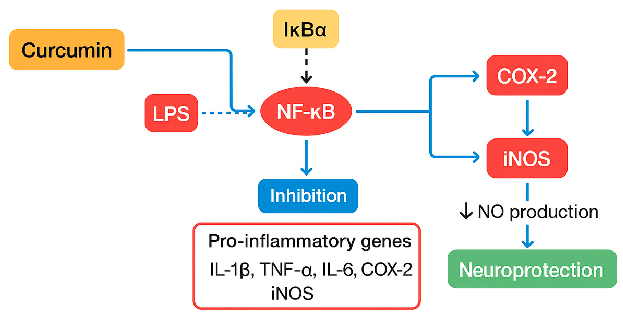
![Curcumin exerts broad-spectrum anti-inflammatory effects predominantly via modulation of the nuclear factor kappa B (NF-κB) signaling pathway [70]. By inhibiting NF-κB activation, curcumin suppresses the transcription of pivotal pro-inflammatory mediators](https://pdfs.citedhealth.com/figures/40944272/226.png)
Descrição
Curcumin's anti-inflammatory mechanisms operate primarily through modulation of the NF-kappa-B signaling pathway. The diagram illustrates how curcumin suppresses neuroinflammatory cascades implicated in Alzheimer's disease, Parkinson's disease, and post-stroke cognitive impairment.
Figure 2
Diagram
623 × 317px
· 75,4 KB
Source Paper
The Neuroprotective Role of Curcumin: From Molecular Pathways to Clinical Translation-A Narrative Review.Cite This Figure
 > Source: Andrea Lehoczki et al. "The Neuroprotective Role of Curcumin: From Molecular Pathways to Clinical Transl." *Nutrients*, 2025. PMID: [40944272](https://pubmed.ncbi.nlm.nih.gov/40944272/)
<figure>
  <img src="https://pdfs.citedhealth.com/figures/40944272/226.png" alt="Curcumin's anti-inflammatory mechanisms operate primarily through modulation of the NF-kappa-B signaling pathway. The diagram illustrates how curcumin suppresses neuroinflammatory cascades implicated in Alzheimer's disease, Parkinson's disease, and post-stroke cognitive impairment." />
  <figcaption>Figure 2. Curcumin's anti-inflammatory mechanisms operate primarily through modulation of the NF-kappa-B signaling pathway. The diagram illustrates how curcumin suppresses neuroinflammatory cascades implicated in Alzheimer's disease, Parkinson's disease, and post-stroke cognitive impairment.<br>  Source: Andrea Lehoczki et al. "The Neuroprotective Role of Curcumin: From Molecular Pathways to Clinical Transl." <em>Nutrients</em>, 2025. PMID: <a href="https://pubmed.ncbi.nlm.nih.gov/40944272/">40944272</a></figcaption>
</figure>